Overview of the Methodological Approach
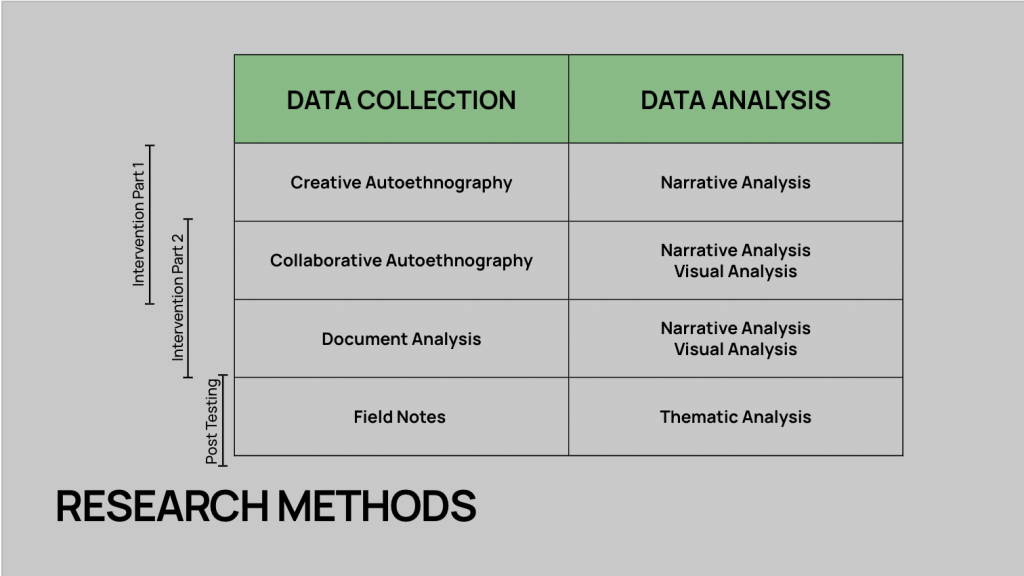
My PGCert action research project adopts a qualitative, practice-based methodology that foregrounds lived experience, reflexivity and institutional critique. The research design combines creative and collaborative autoethnography, document analysis and field notes, allowing different layers of experience, policy and observation to be examined in relation to one another.
Creative Autoethnography
The first phase of the intervention draws on creative autoethnography, positioning personal narrative as a legitimate site of knowledge production. Students write a personal narrative and translate their own life stories into data visualisation using structured prompts, moving from formative experiences to present identity and future orientation. The focus is on their emotional trajectory. This method aligns with creative autoethnography’s emphasis on embodied, evocative storytelling as a way of making sense of experience within wider cultural and educational contexts (Ellis and Bochner, 2006).
Collaborative Autoethnography
The second phase employs collaborative autoethnography, shifting from individual reflection to collective sense-making. This dialogic process reflects collaborative autoethnography’s capacity to surface shared tensions and institutional constraints through collective reflection (Arnold and Norton, 2021). Students collectively compare their narrative infographics with the information requested in a UAL Equality, Diversity and Inclusion monitoring form. By removing elements of their stories that were not represented in the form, they identified gaps between lived experience and institutional categorisation.
Document Analysis
Document analysis is used to critically examine the DEI monitoring form as an institutional artefact. Treating the document as a social text enables questions of representation, omission and standardisation to emerge, situating personal narratives in relation to policy language and bureaucratic structures (Bowen, 2009).
Field Notes and Post-Intervention Reflection
Finally, field notes are used after the intervention to record observations, affective responses and emerging tensions. These notes function as a reflexive account of the research process, acknowledging the partial, situated and interpretive nature of observation in educational settings (Jones et al., 2010).
Bibliography
Arnold, L. and Norton, L. (2021) ‘Problematising pedagogical action research in formal teaching courses and academic development: a collaborative autoethnography’, Educational Action Research, 29(2), pp. 328–345.
Bowen, G.A. (2009) ‘Document analysis as a qualitative research method’, Qualitative Research Journal, 9(2), pp. 27–40.
Ellis, C. and Bochner, A.P. (2006) ‘Analyzing analytic autoethnography’, Journal of Contemporary Ethnography, 35(4), pp. 429–449.
Jones, L., Holmes, R., MacRae, C. and MacLure, M. (2010) ‘Documenting classroom life: how can I write about what I am seeing?’, Qualitative Research, 10(4), pp. 479–491.
Leave a Reply