Diversity work could be described as a phenomenological practice: a way of attending to what gets passed over as routine or an ordinary feature of institutional life.
Ahmed, Sara. On Being Included: Racism and Diversity in Institutional Life
Introduction
What gets lost in translation when a multidimensional being encounters an institution that is doing DEI work that needs to be quantified and measured? What are the opportunities, challenges and risks?
My focus on storytelling spans from self-narration to investigative journalism, the individual in relation to one another, and the individual in relation to the collective. My teaching is across institutions, courses, and modules. In what are all either non- or multidisciplinary contexts, there’s an inevitable emphasis on students leading the direction of their own journey, exploring not only who they are but who they could become. Facilitating this self-exploratory journey is an honour and an immense responsibility.
I’m a white person with no physical disability, and I’m fairly comfortable with the gender assigned to me at birth. I’m also queer, neurodivergent, with another condition classified as a disability (which I’m not comfortable disclosing), and I grew up in a low-income household with little to no access to financial support. All these factors shaped challenges, but also the unquantifiable privilege of being invisible. I have had, at times, the possibility of trading anonymity for safety. I am aware that not everyone is being presented with this choice.
We are asking students to locate their practice often based on proximity to narratives, to interrogate their work with their own positionality. A necessary exercise, it is often not facilitated in a way that allows students to participate without exposing themselves in the classroom, and it’s not necessarily contextualised within the institution they’re in. The intervention can’t be a solution to infrastructure, it’s a heartfelt attempt to open questions and foster reflection in the classroom that are as nuanced as the demographics I have the pleasure of working with. Positionality stories must be practiced critically and carefully; they are not casual attempts at empathy or identification (Cedillo & Bratta, 2019).
Context
The proposed intervention is part of a lecture and workshop I will be holding at the MA Applied Imagination (Creative Enterprise Programme), where I’m Associate lecturer. Students will be approaching the last unit of the course, it will be an opportunity for self-narration and contextualisation now that they will be presenting their work, and their relationship to their work, to teaching staff, their peers, and relevant industry professionals, both during their showcase and final summative assessment.
The workshop is planned to be part of a three-hour session:
- 15 mins: welcome and introduction
- 45 mins: lecture
- 15 mins break
- 1h: workshop
- 45 mins: discussion & feedback
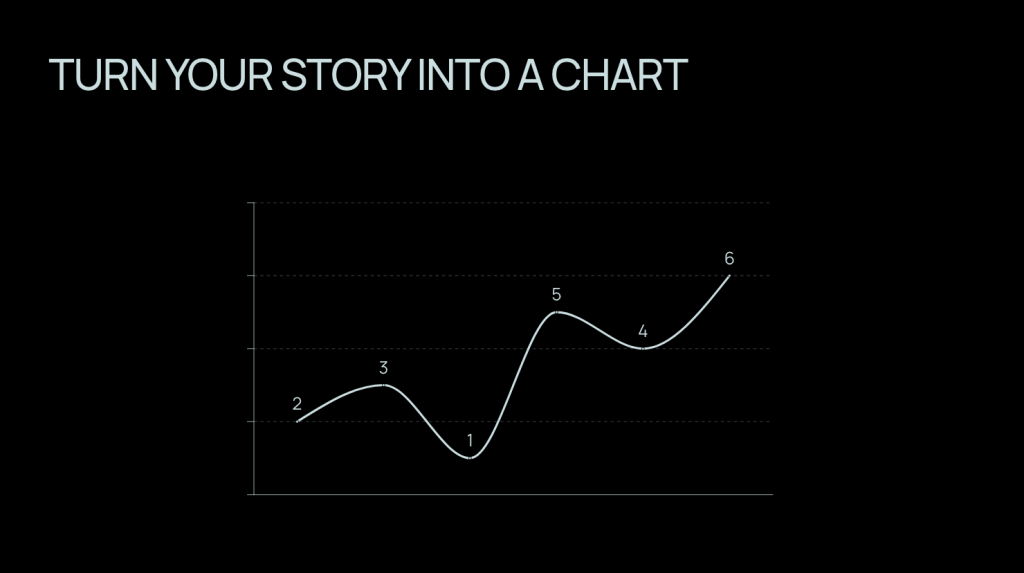
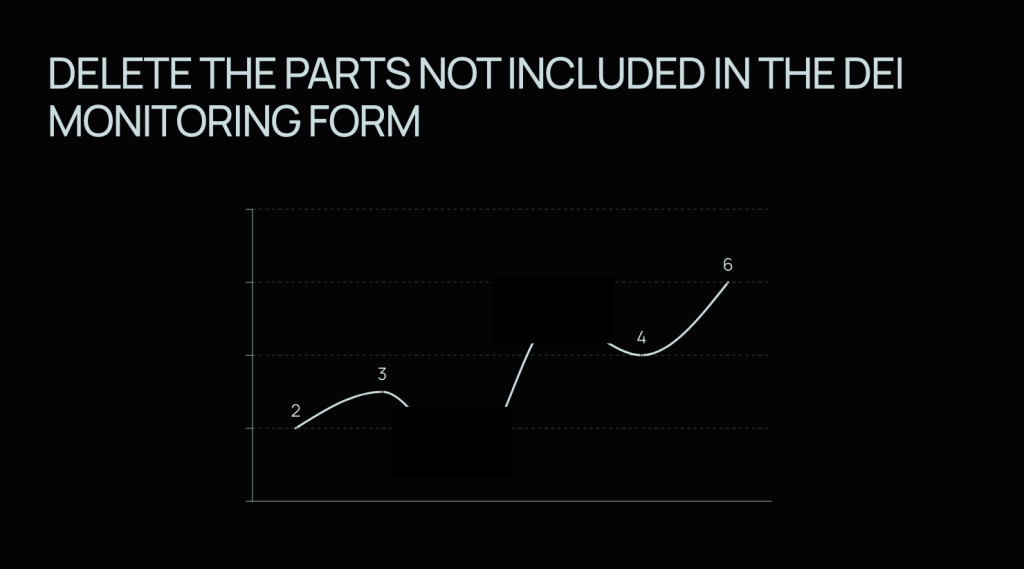
The utility of the intervention is to promote inclusive learning by validating lived experience as an important site of academic inquiry, particularly for those navigating intersecting identities and systems. It addresses the choice of exposure (whenever possible) when discussing one’s own positionality, and takes into consideration the emotional labour implied. It also reframes how DEI data is being collected and analysed. The design of the intervention is also deeply informed by Data Humanism, a movement led by Giorgia Lupi, emphasising the need to include more qualitative and nuanced aspects of data. Jheni Arboine and Siobhan Clay’s Data Workshop’ also has been enlightening.
Inclusive Learning
I actively engage students in debates surrounding identity, socio-political contexts, and emerging forms of critical creativity. The intervention foregrounds storytelling and dialogue as technologies of reflection, allowing students to surface learning edges and explore how their identities are negotiated across social contexts. Ultimately, the workshop encourages a more nuanced understanding of self-narration, highlighting its vulnerability, ethics, and potential for collective insight.
Selfhood can be understood as narrative—we perceive ourselves as protagonists in our own stories, stories we long to share and have reflected back to us. Our identities, are not constructed in isolation but emerge relationally (Cavarero, 2000). These narratives, however, are profoundly influenced by the social norms and conditions within which we exist. Ethical reflection involves critically examining how these norms and conditions inform our sense of self and our responsibilities toward others (Butler, 2025). Personal narratives within academic discourse serve as a powerful method of addressing the lived realities of marginalised, racialised, and gendered groups, ensuring that these experiences are represented and validated (Green, 2025). Storytelling is not only about understanding one’s identity but also about actively engaging in the politics of representation and visibility (Jones & Harris, 2019).
This process needs to be contextualised within an institution’s diversity work. Education’s shift to an efficiency model has involved a cultural and technical shift: the introduction of a set of disciplinary technologies for judging the efficiency and accountability of educational organisations. (Lyotard, 2005). An efficiency model implies measurement of equality, inclusion and diversity. As Sara Ahmed puts it, ‘What are the political implications of this shift? What does it mean to be good at equality or diversity, or for equality or diversity to be a measure of the good?’ (Ahmed, 2012).
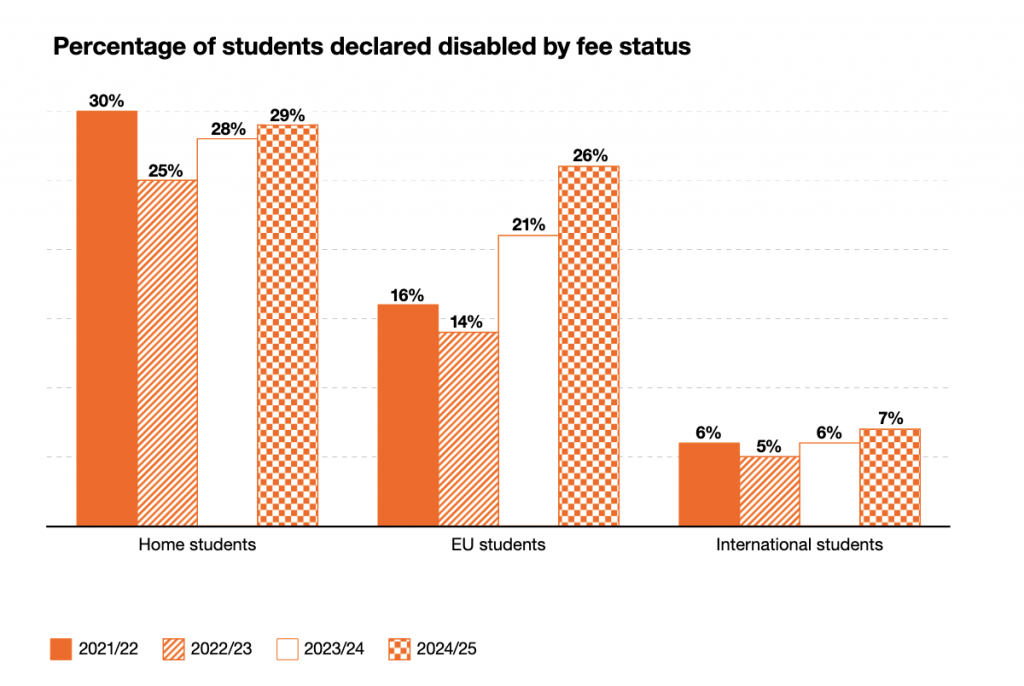
The UAL Equality Diversity and Inclusion Data report 2024 highlights nuances and uncertainties:
- Sexual orientation: 19% to 21% students (Home and Overseas), declared ‘Prefer not to say’ under this section. Should we expand the vocabulary? Is it something they’re currently exploring? Do they feel unsafe or uncomfortable sharing their sexual orientation?
- Disability. There is a substantial difference between the proportion of Home and International students who declare they are disabled. 25% to 30% for Home students, and 5% to 7% for International students. Is this difference due to lack of access, or lack of diagnosis?
- Disability breakdown: 34% of students with a disability declare ‘other or multiple impairments’. Should we ask more nuanced questions? What prompts a student to choose ‘other’, when aware of a disability?
Reflection
I’ve already delivered the first part of the intervention, which is now revised. Students, after a lecture on self-narration, completed the task of writing text, scoring the different points and developing an arc of narration as an infographic. When I asked this group of students whether they’d be more comfortable sharing the text they wrote or the line resulted, they overwhelmingly preferred the second option. Only one student out of 23 said they would prefer the first option.
I’ve received positive feedback from my colleagues, but they have also flagged risks and challenges (addressed below). Most of the feedback I received has been on expanding and clarifying the practical aspects of this intervention, and how this sits within the course curriculum and the programme (Creative Enterprise). Those who shared feedback with me have had the occasion to work with me already, so I will further include feedback from a range of professionals who have a less biased perspective.
Equality and inclusion monitoring collect the very data that makes progress visible and quantifiable. It is of immense value to signpost what needs to be addressed and whether policies and strategies have impact. But intersectionality isn’t a sum of all factors; it’s to acknowledge the unrepeatable essence in which identity and experience meet one another.
Challenges:
- This intervention is heavily reliant on a visual process and output. I should be aware of students with visual impairment beforehand, but not all students with a visual impairment are diagnosed.
- I’m asking students to rate events from 0 to 6, which is presenting a challenge for students who have dyscalculia.
- This isn’t an occasion for pitting students against the institution they’re in, as it ultimately is holding space for this conversation and interrogation to happen.
Risks:
- Students will be asked to look back and look forward in their journey. This is still opening up reflections on what could be negative feelings or potentially traumatic memories. I will remind students that this needs to be an event that fostered positive growth in them. I will also share an outline of the session beforehand, including an outline of the tasks they will be asked to work on and the subjects covered.
Action
I propose embedding this intervention systematically at strategic reflective points within the curriculum, specifically at moments when students are preparing for external critique or assessment. While initially developed for MA Applied Imagination students, the flexibility and emphasis on personal narrative and qualitative data mean it could adapt well across other teaching contexts. In integrating this into my ongoing practice, it reinforces my commitment to a humanistic approach to data collection, aligning institutional DEI objectives with authentic student experiences (Ahmed, 2012; Lupi, 2017).
Evaluation
Through this intervention, I’ve deepened my understanding of the complexities around intersectional identity work within education, particularly how visibility can simultaneously empower and risk student exposure. To evaluate effectiveness, I will utilise anonymous feedback, observational notes, and reflective journals to track changes in students’ confidence and criticality around positionality over time. Success indicators might include enhanced clarity in students’ reflective writing and presentations, increased peer dialogues on positionality, and positive self-assessments from students on their comfort level in engaging in positionality work.
The overall result of the intervention will need to be critically analysed. I found Alice Bradbury Critical Race Theory Framework For Education Policy Analysis helpful, especially ‘Context of practice’, which would be framed not for policy, but for the data collection process:
- What is the impact of the *data collection process* on pedagogy and practice? How does the *data collection process* produce practices that result in disparities through seemingly neutral practices? (..)
Conclusion
My understanding of the delicate balance between exposure and empowerment has deepened significantly. My positionality, navigating privilege, marginalisation, visibility, and invisibility, has enhanced the understanding of my responsibility in creating spaces where identity exploration is voluntary, critical, and supportive. Ahmed’s critique of diversity performance profoundly informed my reflection and will inform my outlook on reaffirming the need to advocate for meaningful, nuanced approaches within institutional frameworks. This isn’t about trying to provide anonymity, but choice — when this is possible, and to investigate to what extent choice can be provided and exposure is institutionalised. Exposure can be empowering when informed by a conscious decision rather than enforced.
Moving forward, I will commit to iteratively revisit this intervention, pursuing deeper engagement with critical DEI literature and professional dialogues. I know my lack of experiential knowledge is not something I can replace with literature, and I will carry this awareness in empathetic dialogue and openness to critique.
References
Ahmed, S. (2012) On being included: Racism and diversity in Institutional Life. Durham: Duke University Press.
Cedillo, C.V. and Bratta, P. (2019) ‘Relating our experiences: The practice of positionality stories in student-centered pedagogy’, College Composition & Communication, 71(2), pp. 215–240. doi:10.58680/ccc201930421.
Holman Jones, S.L. and Harris, A.M. (2019) Queering autoethnography. New York, NY: Routledge.
Cavarero, A. (2014) Relating narratives: Storytelling and Selfhood. Hoboken: Taylor and Francis.
Butler, J. (2025) Giving an account of oneself. New York: Fordham University Press.
Green, M. (2025) Narrating self, narrating us: Autoethnography in Black Women’s Storytelling, BERA. Available at: https://www.bera.ac.uk/blog/narrating-self-narrating-us-autoethnography-in-black-womens-storytelling (Accessed: 27 May 2025).
Lupi, G. (2017) Data humanism, giorgialupi. Available at: https://giorgialupi.com/data-humanism-my-manifesto-for-a-new-data-wold (Accessed: 15 July 2025).
Lyotard, J.-F. et al. (2005) The postmodern condition: A report on knowledge. New York: Manchester University Press.
Del Rosso, E. (2024) Imagining a new journalism: EUROPEAN PRESS FUTURE AT THE UAL, European Press Prize. Available at: https://www.europeanpressprize.com/imagining-a-new-journalism-european-press-future-at-the-ual/ (Accessed: 15 July 2025).
University of the Arts London (2024) EDI Data Report 2024. London: University of the Arts London. Available at: https://www.arts.ac.uk/__data/assets/pdf_file/0030/472836/UAL-EDI-data-report-2024-PDFA.pdf (Accessed: 15 July 2025).
Bradbury, A. (2019) ‘A critical race theory framework for education policy analysis: The case of bilingual learners and assessment policy in England’, Race Ethnicity and Education, 23(2), pp. 241–260. doi:10.1080/13613324.2019.1599338.
Leave a Reply