Action research is often described as a spiral, foregrounding the ongoing relationship between action, observation, reflection and revision. In this blog post, I draw a parallel between this methodological structure and my own research process, questioning where the spiral meaningfully begins and how its stages overlap in practice. Here, observing and acting are often entangled, and each revised plan emerges as both an outcome and a new point of departure.
What is my starting point in the Action Research Spiral?
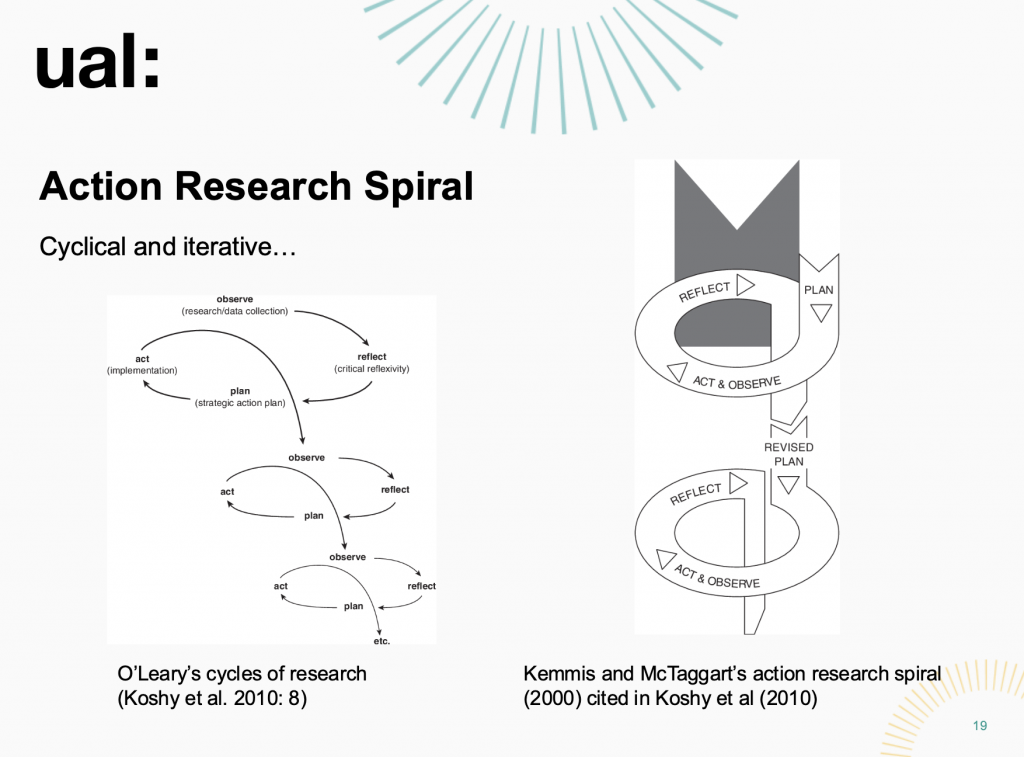
In my experience, both O’Leary and Kemmis & McTaggart’s elements are relevant: first, the breakdown of act and observe (even though both are present in the testing of the intervention). From the latter, I found it helpful to embed the ‘Revised Plan’ within the spiral to separate reflection from consequential planning.
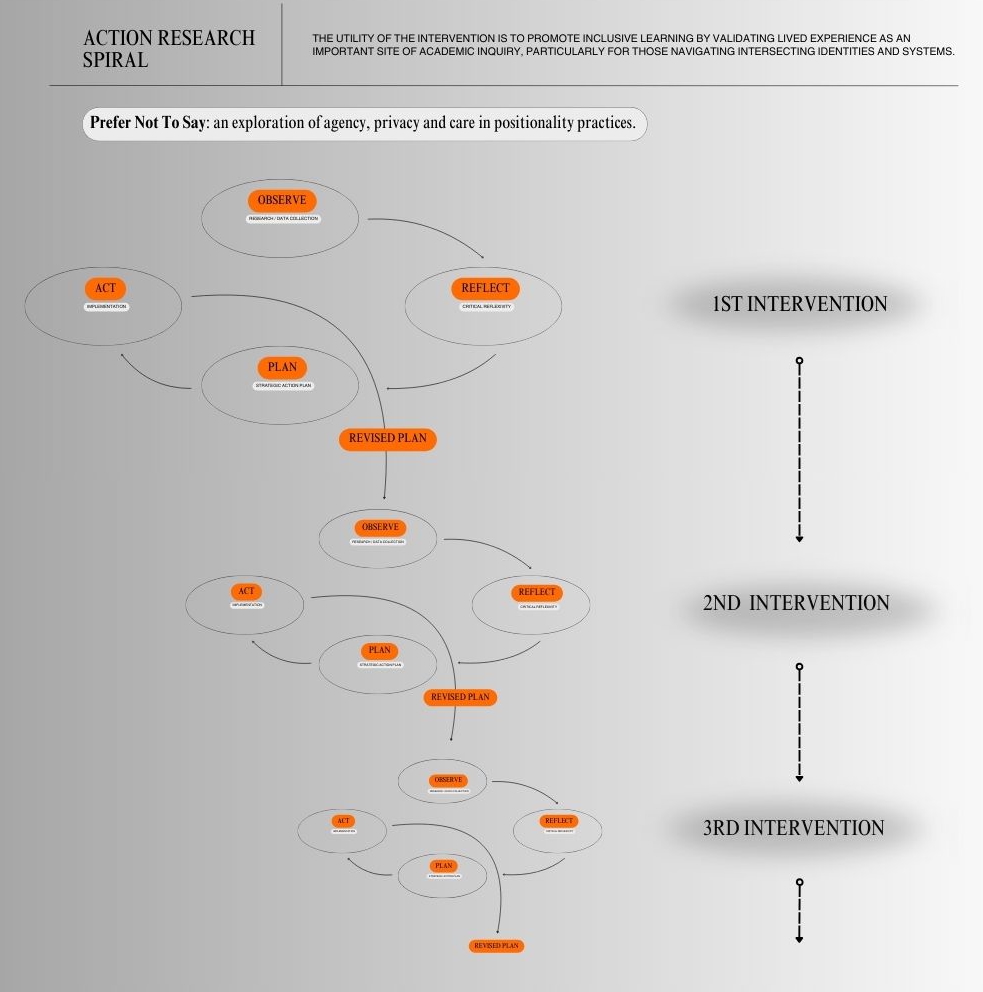
My own action research spiral:
1st Intervention
Observe (research / data collection)
Positionality is often not supported in ways that allow students to participate without exposing themselves in the classroom, and it’s not necessarily contextualised within the institution in which they’re situated.
Data: UAL Equality Diversity and Inclusion Data report 2024
Reflect (critical reflexivity)
IP Reflective Report
Intervention Aims:
- To promote inclusive learning by validating lived experience as an important site of academic inquiry, particularly for those navigating intersecting identities and systems.
- To address the choice of exposure when discussing one’s own positionality, and take into consideration the emotional labour implied.
- To reframe how DEI data is being collected and analysed.
Plan ( strategic action plan)
- In-depth development of the workshop
- Outline of methods/methodology of research
- Outline of data collection strategy
- Setting up the session with the course team
- Comms to share with students beforehand
Act (implementation)
Students will translate their personal narratives into heatmaps shared in real time with the whole class.
Observe (research/data collection)
Students will delete from the heat map the parts that the DEI monitoring form doesn’t cover.
Reflect (critical reflexivity)
Students will collectively reflect on their own experiential knowledge and the context of institutionalised education.
Researcher’s input
- Post-workshop data collection on students’ experience
- Data visualisation + analysis
- Reflection on overall process and students and staff’s feedback and testimonies.
— Revised Plan
2nd Intervention
- Plan
- Act
- Observe
- Reflect
— Revised Plan
3rd Intervention
- Plan
- Act
- Observe
- Reflect
— Revised Plan
I then developed a draft of the mapping of my Action Research Spiral:
Leave a Reply