Tuesday 28th October, during class hours.
14 students from the MA Applied Imagination, CSM, Creative Enterprise programme
3-hour session: 1.5-hour lecture, 15-minute break, 1 hour 15 minutes for the intervention
The session was structured in two parts: a lecture on data analysis, followed by an intervention designed to translate theoretical concepts into an experiential exercise.
Part One: Lecture on Data Analysis
The lecture introduced key conceptual frameworks around data, analysis, and representation. It roughly included:
- Data reflects complex realities, but is often reduced and oversimplified when analysed and visualised.
- Predictive technologies and big data standardise information and shape behaviour.
- Big Data prioritises patterns over individual meaning or context.
- Common data visualisation practices favour speed and clarity over nuance and complexity.
- Extractivism in data and research reproduces unequal power relations by taking knowledge without reciprocity.
This theoretical grounding set the critical angle for the intervention that followed.
Part Two: Intervention
Intervention slides :
First Stage of Data Analysis
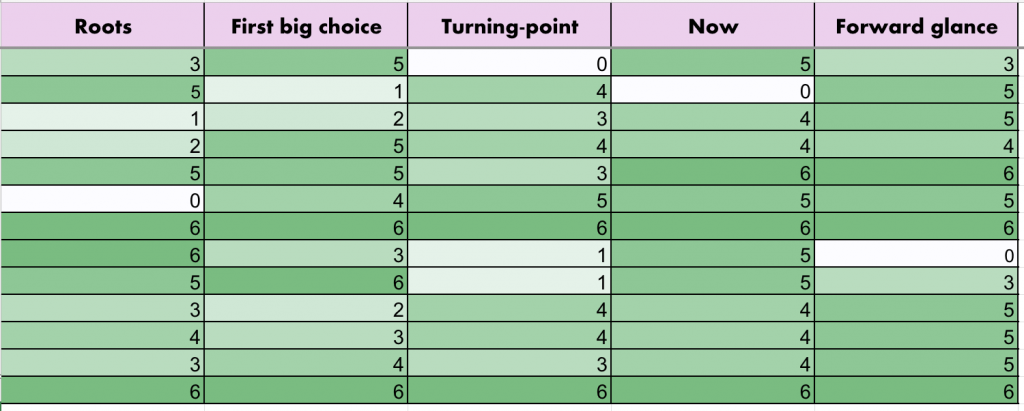
Observations from students
- The data analysis began optimistically; the lowest score for the snapshot opener was 2.
- The turning point emerged as overall negative.
- Between ‘Now’ and ‘Forward glance’ Scores shifted notably, for example from 5 → 0 and 0 → 5. Hopes and anxiety for the future?
These early patterns highlighted emotional trajectories that were not immediately visible prior to the exercise. It also contextualised their story within other people’s.
Second Stage of Data Analysis
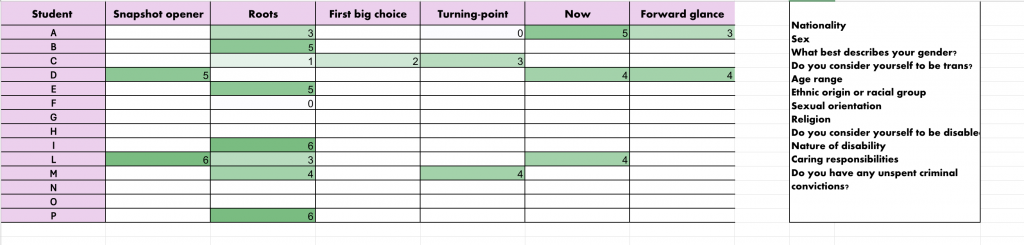
Observations from students
- DEI forms do not reflect much personal information.
- What remains is largely focused on past life. This information is crucial, but it does not represent complexity.
- My identity feels flattened.
- Roots refers to where you are coming from, not where you are headed.
- We do not necessarily consider our starting point as something that permeates our lives at all times.
- I want to have a sense of agency; I can turn things around.
- There is a sense of otherness when filling in a DEI form. Often I have to add “other” because my ethnicity is not listed.
- I feel like I am looking at myself the way I am being looked at.
These reflections revealed tensions between lived experience and institutional modes of categorisation.
Why is there such an emphasis on background?
- These forms act as a benchmark for and from the government.
- Background defines you.
- Only 17 Iranian students are recorded when there are over 80 million people; the success rate feels low.
- Background checking.
Motivations for Selecting “Prefer Not to Say”
- Privacy.
- To avoid rejection.
- When there is no straightforward answer, it is sometimes the quickest decision.
- Often I go back and forth about whether I am comfortable disclosing certain information.
- When there is no other option.
- Selecting “white man” might exclude me from an opportunity.
Revised Plan: Adjustments
Following reflection on the intervention, several revisions were identified:
- Some students experienced difficulty accessing the spreadsheet on their phones; ensuring all participants have access to a laptop is necessary.
- If a student does not have a laptop, they should borrow one from a peer or from me, ensuring they are not sharing personal data.
- Further consideration is needed on how to collect data from those not participating in the discussion without over-engineering the intervention.
- It is also important to avoid over-extracting information from students.
Leave a Reply