This phase of the research examines two further iterations of the intervention delivered in distinct institutional, spatial, and temporal conditions: an in-person, voluntary session with BA Critical Practice in Fashion Media Year 3 students at London College of Fashion, and an online session delivered during class hours with BA UX/UI Design Year 2 students at Ravensbourne University.
Intervention 2
BA Critical Practice in Fashion Media, Year 3 – London College of Fashion
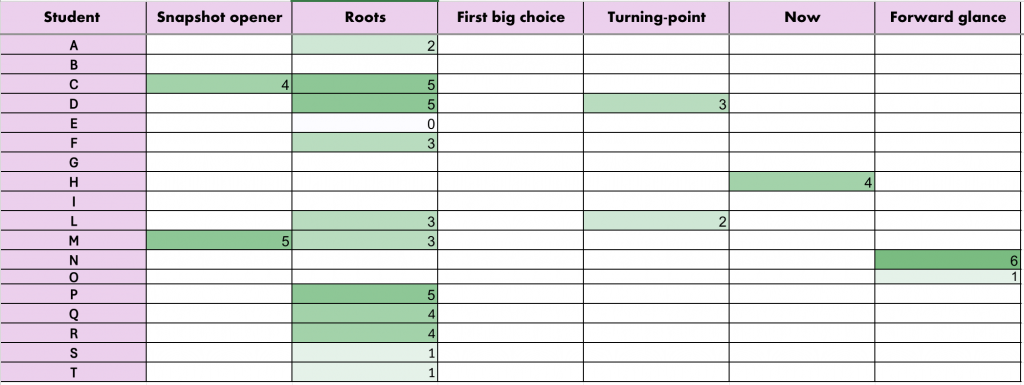
4 students, in person, voluntary participation, close to the assessment period
Step 1

Step 2

Pros
- The small group created a highly intimate setting, with most participants already part of a close group of friends.
- Discussions were extremely personal, layered, and nuanced, allowing students to articulate complex emotional trajectories.
- All participants actively contributed, resulting in sustained and in-depth dialogue.
- The in-person format supported attentiveness, care, and responsiveness to others’ contributions.
Cons
- The small number of participants weakened agency around privacy and disclosure.
- Because sharing became the dominant mode, students may have felt an implicit pressure to disclose personal information.
- This tension felt particularly pronounced given that choice around exposure is a core ethical concern of the intervention.
- Participation was limited by timing, excluding students with work, caring, or other extra-curricular responsibilities.
Data analysis
- The dataset is small, limiting comparative depth and variation.
- Emotional fluctuations appear milder, with fewer sharp drops in sentiment.
- Despite this, the overall emotional trajectory follows a pattern consistent with previous interventions.
- In Step 2, Roots once again emerges as the most populated category, suggesting a recurring emphasis embedded within the DEI monitoring framework itself.
Intervention 3
BA UX/UI Design, Year 2 – Ravensbourne University
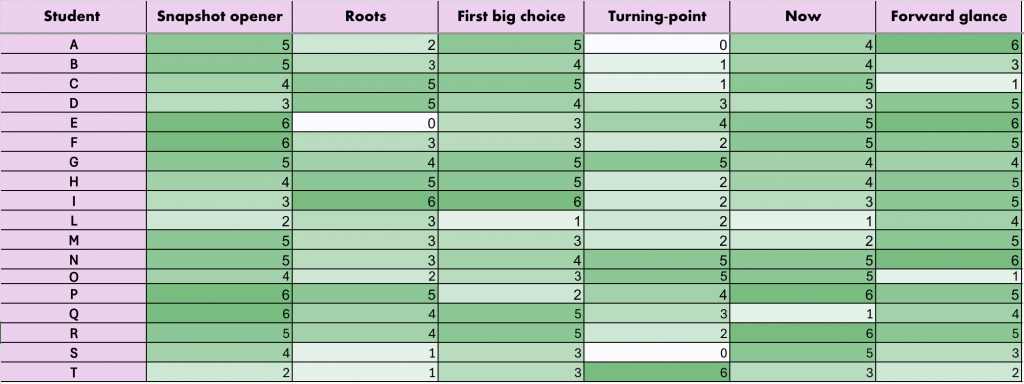
18 students, online, delivered during class hours
Step 1
Step 2
Pros
- Most students were able to participate, resulting in a dataset of appropriate scale.
- Time management was more effective within a timetabled session.
- The chat function enabled participation without requiring verbal contribution, lowering barriers for some students.
- The larger cohort allowed for greater variation in emotional scoring across stages.
Cons
- Anonymity was partially compromised, as student identifiers were assigned individually via private chat.
- Discussion felt more limited, with students requiring additional time before sharing reflections.
- The online format felt in tension with the deeply personal nature of the exercise.
- Moderation was more challenging, and many embodied or affective cues were lost.
- Subtle forms of engagement or disengagement were difficult to perceive.
Data analysis
- The dataset is sufficiently large and more nuanced than in smaller-scale iterations.
- Emotional variation is clearer across stages, allowing for more reliable comparative analysis.
- Once again, in Step 2, Roots dominates responses, reinforcing questions around the framing and weighting of the monitoring tool.
Final reflection
- Dataset size significantly affects both analytical depth and ethical dynamics.
- Delivering the intervention during class hours increases accessibility and participation.
- In-person settings better support emotionally reflective and relational work.
- A key unresolved question remains: how can the intervention continue to include those uncomfortable with verbal or visible self-disclosure?
Leave a Reply