This project underwent a significant shift in both subject knowledge and methodology as it progressed. What began as a structured intervention centred on positionality gradually became a more open, collective inquiry into how students locate themselves not only within their own narratives, but within the institution itself. This change was largely driven by students’ responses. Their willingness to engage, question, and reframe positionality revealed a strong need for it to be embedded at the core of their practice, rather than treated as a collateral exercise.
One of the most unexpected outcomes concerns the format. While digital tools did not always amplify nuance as I initially hoped, the use of written chat-based contributions enabled students who were less comfortable speaking to participate. However, the limitations of these formats also became visible. The intervention would benefit from further experimentation with more sophisticated and creative forms of data visualisation, ideally informed by students’ own subjects and skills. There is clear potential in exploring non-digital or hybrid approaches, such as knitting, painting, mapping, and other material translations of data, to deepen engagement and amplify complexity.
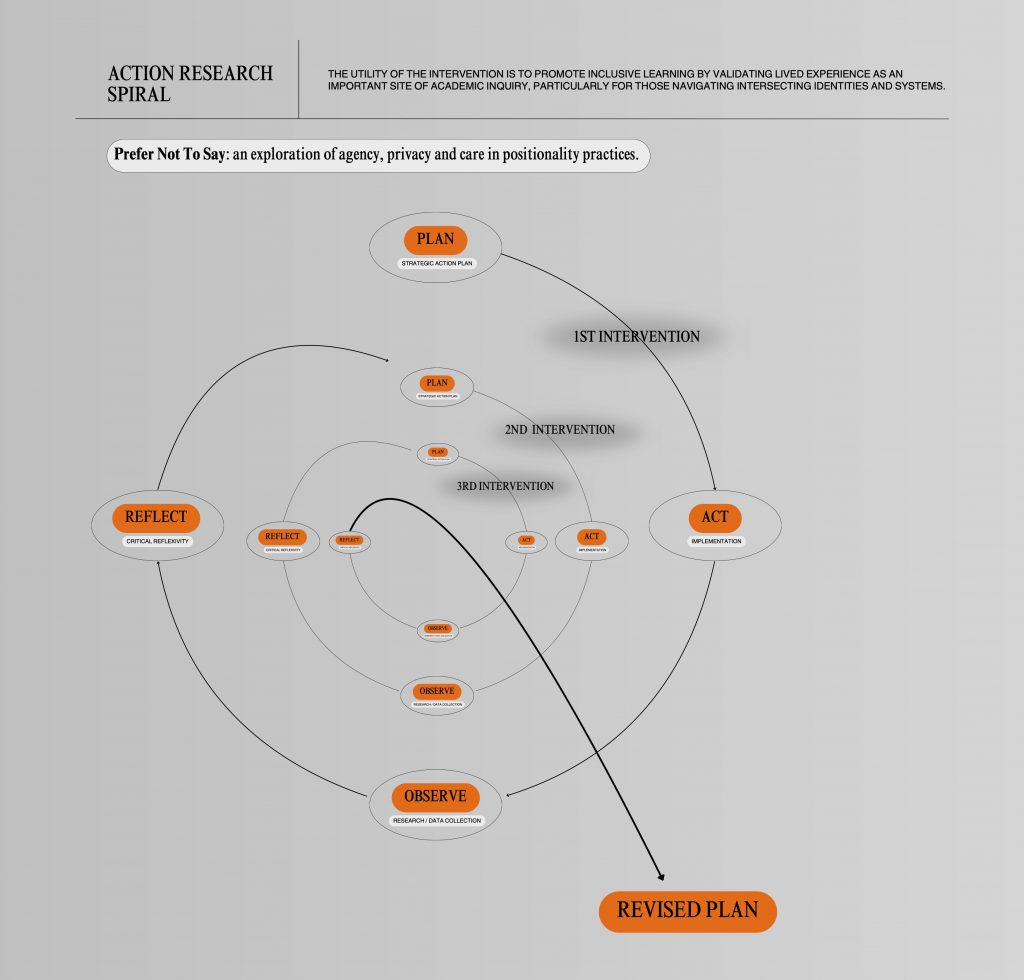
This project is grounded in action research as a cyclical and reflexive methodology, in which knowledge is produced through situated action, critical reflection, and iterative revision rather than through fixed or extractive research designs. That being said, I’m also reframing whether I can consider the Action Research process as a spiral or a cycle, as the ‘Revised Plan’ was actually informed by context – the three interventions have been tested very close to each other. I’d now rather frame it as a cycle that will inform a separate spiral once I develop an in-depth Revised Plan.
My dual role as teacher and researcher shaped both the design and the ethical limits of the intervention. Being embedded within the structures I was interrogating required ongoing reflexivity around authority, care, and consent. This positionality informed my decision to prioritise abstraction, anonymity, and choice, recognising that my responsibility was not only to generate insight but to minimise harm within an uneven power relationship.
What brought me the most joy was students’ openness to understanding positionality as a collective experience. Their ability to hold space for perspectives that differed from, or even conflicted with. Students consistently approached one another’s experiences with care, recognising them as something to be welcomed rather than judged.
The fact that the exercise resonated emotionally, rather than remaining a purely intellectual exercise, felt like the project’s most meaningful success.
At the same time, this raised important ethical considerations. A key challenge moving forward is finding ways to amplify different forms of engagement without over-engineering the intervention or over-extracting personal information from students. This project has reinforced my commitment to a balanced, mindful approach to experimentation, one that values depth, consent, and reciprocity over scale or technical complexity.
Through this process, I have developed skills in collaborative data collection and analysis, reframing data analysis as a participatory and communal practice rather than a solitary one. Looking ahead, I aim to expand this approach as a core aspect of my pedagogical practice, continuing to explore the intersection of the personal, social, collective, and institutional dimensions of identity within teaching and learning.
Leave a Reply