Category: ARP Unit

  • Final Reflections

    This project underwent a significant shift in both subject knowledge and methodology as it progressed. What began as a structured intervention centred on positionality gradually became a more open, collective inquiry into how students locate themselves not only within their own narratives, but within the institution itself. This change was largely driven by students’ responses. Their willingness to engage, question, and reframe positionality revealed a strong need for it to be embedded at the core of their practice, rather than treated as a collateral exercise.

    One of the most unexpected outcomes concerns the format. While digital tools did not always amplify nuance as I initially hoped, the use of written chat-based contributions enabled students who were less comfortable speaking to participate. However, the limitations of these formats also became visible. The intervention would benefit from further experimentation with more sophisticated and creative forms of data visualisation, ideally informed by students’ own subjects and skills. There is clear potential in exploring non-digital or hybrid approaches, such as knitting, painting, mapping, and other material translations of data, to deepen engagement and amplify complexity.

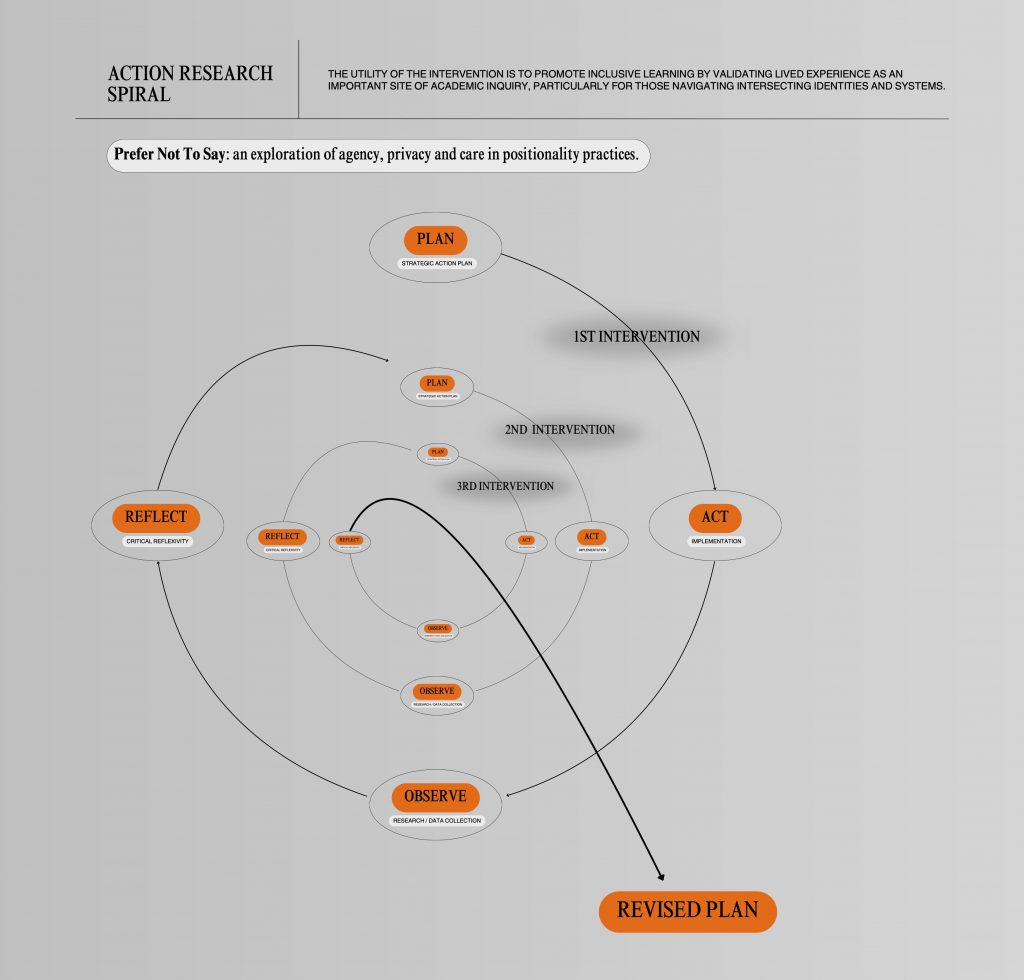
    This project is grounded in action research as a cyclical and reflexive methodology, in which knowledge is produced through situated action, critical reflection, and iterative revision rather than through fixed or extractive research designs. That being said, I’m also reframing whether I can consider the Action Research process as a spiral or a cycle, as the ‘Revised Plan’ was actually informed by context – the three interventions have been tested very close to each other. I’d now rather frame it as a cycle that will inform a separate spiral once I develop an in-depth Revised Plan.
    My dual role as teacher and researcher shaped both the design and the ethical limits of the intervention. Being embedded within the structures I was interrogating required ongoing reflexivity around authority, care, and consent. This positionality informed my decision to prioritise abstraction, anonymity, and choice, recognising that my responsibility was not only to generate insight but to minimise harm within an uneven power relationship.

    What brought me the most joy was students’ openness to understanding positionality as a collective experience. Their ability to hold space for perspectives that differed from, or even conflicted with. Students consistently approached one another’s experiences with care, recognising them as something to be welcomed rather than judged.

    The fact that the exercise resonated emotionally, rather than remaining a purely intellectual exercise, felt like the project’s most meaningful success.

    At the same time, this raised important ethical considerations. A key challenge moving forward is finding ways to amplify different forms of engagement without over-engineering the intervention or over-extracting personal information from students. This project has reinforced my commitment to a balanced, mindful approach to experimentation, one that values depth, consent, and reciprocity over scale or technical complexity.

    Through this process, I have developed skills in collaborative data collection and analysis, reframing data analysis as a participatory and communal practice rather than a solitary one. Looking ahead, I aim to expand this approach as a core aspect of my pedagogical practice, continuing to explore the intersection of the personal, social, collective, and institutional dimensions of identity within teaching and learning.


  • Intervention 2 and 3: Comparative reflections across contexts

    This phase of the research examines two further iterations of the intervention delivered in distinct institutional, spatial, and temporal conditions: an in-person, voluntary session with BA Critical Practice in Fashion Media Year 3 students at London College of Fashion, and an online session delivered during class hours with BA UX/UI Design Year 2 students at Ravensbourne University.


    Intervention 2

    BA Critical Practice in Fashion Media, Year 3 – London College of Fashion
    4 students, in person, voluntary participation, close to the assessment period

    Step 1

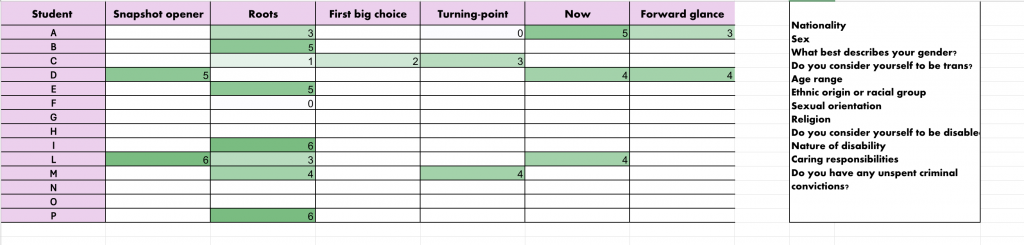
    Step 2

    Pros

    • The small group created a highly intimate setting, with most participants already part of a close group of friends.
    • Discussions were extremely personal, layered, and nuanced, allowing students to articulate complex emotional trajectories.
    • All participants actively contributed, resulting in sustained and in-depth dialogue.
    • The in-person format supported attentiveness, care, and responsiveness to others’ contributions.

    Cons

    • The small number of participants weakened agency around privacy and disclosure.
    • Because sharing became the dominant mode, students may have felt an implicit pressure to disclose personal information.
    • This tension felt particularly pronounced given that choice around exposure is a core ethical concern of the intervention.
    • Participation was limited by timing, excluding students with work, caring, or other extra-curricular responsibilities.

    Data analysis

    • The dataset is small, limiting comparative depth and variation.
    • Emotional fluctuations appear milder, with fewer sharp drops in sentiment.
    • Despite this, the overall emotional trajectory follows a pattern consistent with previous interventions.
    • In Step 2, Roots once again emerges as the most populated category, suggesting a recurring emphasis embedded within the DEI monitoring framework itself.

    Intervention 3

    BA UX/UI Design, Year 2 – Ravensbourne University
    18 students, online, delivered during class hours

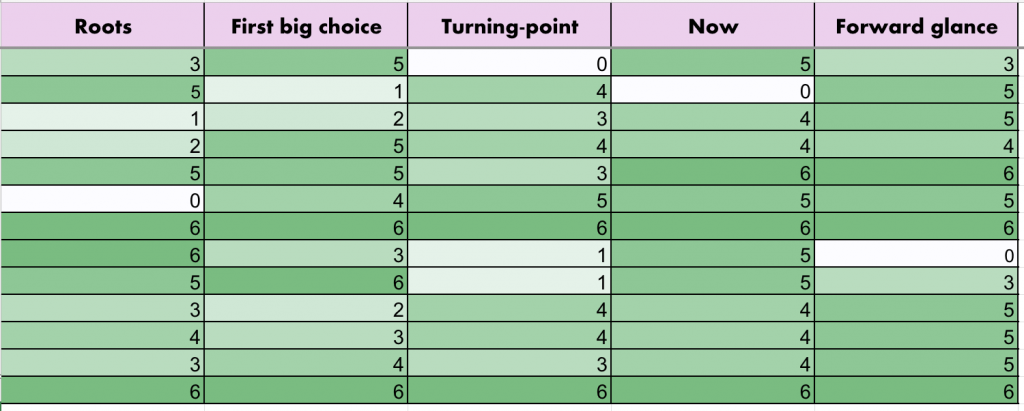
    Step 1

    Step 2

    Pros

    • Most students were able to participate, resulting in a dataset of appropriate scale.
    • Time management was more effective within a timetabled session.
    • The chat function enabled participation without requiring verbal contribution, lowering barriers for some students.
    • The larger cohort allowed for greater variation in emotional scoring across stages.

    Cons

    • Anonymity was partially compromised, as student identifiers were assigned individually via private chat.
    • Discussion felt more limited, with students requiring additional time before sharing reflections.
    • The online format felt in tension with the deeply personal nature of the exercise.
    • Moderation was more challenging, and many embodied or affective cues were lost.
    • Subtle forms of engagement or disengagement were difficult to perceive.

    Data analysis

    • The dataset is sufficiently large and more nuanced than in smaller-scale iterations.
    • Emotional variation is clearer across stages, allowing for more reliable comparative analysis.
    • Once again, in Step 2, Roots dominates responses, reinforcing questions around the framing and weighting of the monitoring tool.

    Final reflection

    • Dataset size significantly affects both analytical depth and ethical dynamics.
    • Delivering the intervention during class hours increases accessibility and participation.
    • In-person settings better support emotionally reflective and relational work.
    • A key unresolved question remains: how can the intervention continue to include those uncomfortable with verbal or visible self-disclosure?
  • Data Analysis, Extractivism, and the Politics of Knowledge Production

    Data analysis is often positioned as a neutral, technical process, yet it is deeply shaped by historical, political, and epistemic power structures. Contemporary data cultures frequently prioritise scale, speed, and prediction, reinforcing forms of abstraction that strip knowledge from its social and relational context. As Warren Neidich argues through the concept of the “Statisticon”, predictive technologies reduce future possibilities into probabilities, encouraging cultural habituation to standardised narratives that resist complexity and uncertainty (Neidich, 2018).

    Ch’ixinakax utxiwa: On Practices and Discourses of Decolonization by Silvia Rivera Cusicanqui

    This logic mirrors extractivist models more commonly associated with land and resource exploitation. Walter Rodney’s analysis of colonial extractivism demonstrates how underdevelopment is produced through the systematic extraction of labour and resources for external gain (Rodney, 1972). When applied to research and data practices, extractivism describes situations in which knowledge is taken, decontextualised, and repurposed without reciprocity, disproportionately benefiting institutions or researchers while disempowering those from whom the knowledge originates.

    Leanne Betasamosake Simpson (photograph). Source: University of Melbourne – Australian Centre for Indigenous Knowledge Systems.

    Leanne Betasamosake Simpson extends this critique through the notion of cognitive extractivism, describing the extraction of Indigenous ideas into economic or symbolic capital while severing them from the relationships that give them meaning (Simpson, 2017). Similarly, Silvia Rivera Cusicanqui highlights how epistemic extractivism operates through academic citation economies, where Indigenous and decolonial knowledge is consumed in “regurgitated” forms that reinforce hierarchical structures of legitimacy (Rivera Cusicanqui, 2012).

    Within data analysis, these dynamics are intensified by big data paradigms that privilege pattern recognition over situated meaning. As Giorgia Lupi notes, the dominance of quantitative abstraction risks producing data systems devoid of humanity, where uncertainty, subjectivity, and lived experience are systematically excluded (Lupi, 2017).

    My work is positioned as a critical response to these extractive tendencies. Rather than treating data as a raw material to be mined, I approach it as relational and narrative, foregrounding emotional trajectories, positionality, and context. By resisting purely extractive logics, my practice seeks to reframe data analysis as an ethical, situated act of storytelling rather than a neutral process of reduction.


    References

    Lupi, G. (2017) Data Humanism. Available at: https://giorgialupi.com (Accessed: date).

    Neidich, W. (2018) Glossary of Cognitive Activism. Berlin: Archive Books.

    Rivera Cusicanqui, S. (2012) Ch’ixinakax utxiwa: On Decolonising Practices and Discourses. Buenos Aires: Tinta Limón.

    Rodney, W. (1972) How Europe Underdeveloped Africa. London: Bogle-L’Ouverture Publications.

    Simpson, L.B. (2017) As We Have Always Done: Indigenous Freedom through Radical Resistance. Minneapolis: University of Minnesota Press.

  • First Intervention

    Tuesday 28th October, during class hours.

    14 students from the MA Applied Imagination, CSM, Creative Enterprise programme
    3-hour session: 1.5-hour lecture, 15-minute break, 1 hour 15 minutes for the intervention

    The session was structured in two parts: a lecture on data analysis, followed by an intervention designed to translate theoretical concepts into an experiential exercise.

    Part One: Lecture on Data Analysis

    The lecture introduced key conceptual frameworks around data, analysis, and representation. It roughly included:

    • Data reflects complex realities, but is often reduced and oversimplified when analysed and visualised.
    • Predictive technologies and big data standardise information and shape behaviour.
    • Big Data prioritises patterns over individual meaning or context.
    • Common data visualisation practices favour speed and clarity over nuance and complexity.
    • Extractivism in data and research reproduces unequal power relations by taking knowledge without reciprocity.

    This theoretical grounding set the critical angle for the intervention that followed.

    Part Two: Intervention

    Intervention slides :

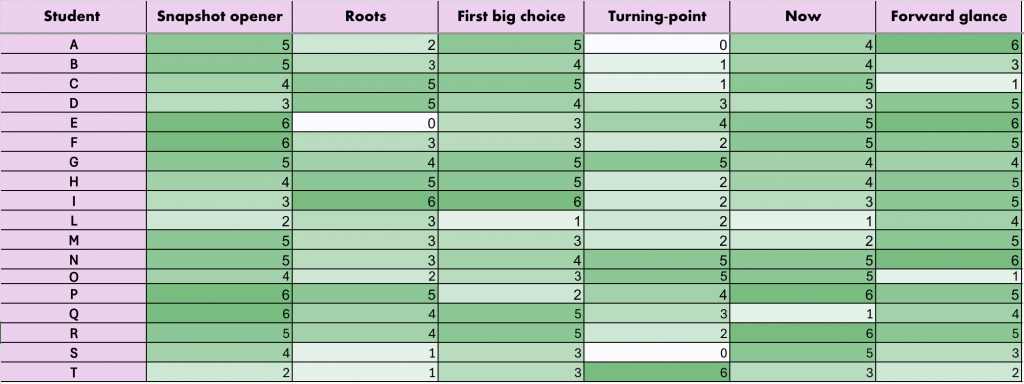
    First Stage of Data Analysis

    Observations from students

    • The data analysis began optimistically; the lowest score for the snapshot opener was 2.
    • The turning point emerged as overall negative.
    • Between ‘Now’ and ‘Forward glance’ Scores shifted notably, for example from 5 → 0 and 0 → 5. Hopes and anxiety for the future?

    These early patterns highlighted emotional trajectories that were not immediately visible prior to the exercise. It also contextualised their story within other people’s.

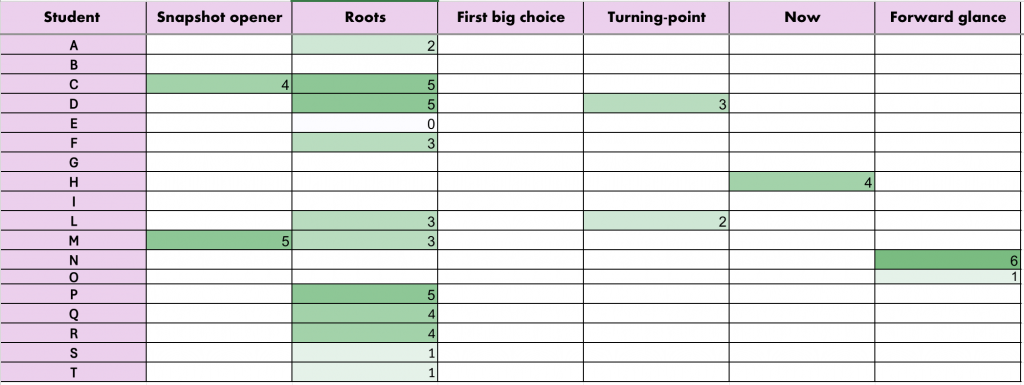
    Second Stage of Data Analysis

    Observations from students

    • DEI forms do not reflect much personal information.
    • What remains is largely focused on past life. This information is crucial, but it does not represent complexity.
    • My identity feels flattened.
    • Roots refers to where you are coming from, not where you are headed.
    • We do not necessarily consider our starting point as something that permeates our lives at all times.
    • I want to have a sense of agency; I can turn things around.
    • There is a sense of otherness when filling in a DEI form. Often I have to add “other” because my ethnicity is not listed.
    • I feel like I am looking at myself the way I am being looked at.

    These reflections revealed tensions between lived experience and institutional modes of categorisation.

    Why is there such an emphasis on background?

    • These forms act as a benchmark for and from the government.
    • Background defines you.
    • Only 17 Iranian students are recorded when there are over 80 million people; the success rate feels low.
    • Background checking.

    Motivations for Selecting “Prefer Not to Say”

    • Privacy.
    • To avoid rejection.
    • When there is no straightforward answer, it is sometimes the quickest decision.
    • Often I go back and forth about whether I am comfortable disclosing certain information.
    • When there is no other option.
    • Selecting “white man” might exclude me from an opportunity.

    Revised Plan: Adjustments

    Following reflection on the intervention, several revisions were identified:

    • Some students experienced difficulty accessing the spreadsheet on their phones; ensuring all participants have access to a laptop is necessary.
    • If a student does not have a laptop, they should borrow one from a peer or from me, ensuring they are not sharing personal data.
    • Further consideration is needed on how to collect data from those not participating in the discussion without over-engineering the intervention.
    • It is also important to avoid over-extracting information from students.

  • Research Methods

    Overview of the Methodological Approach

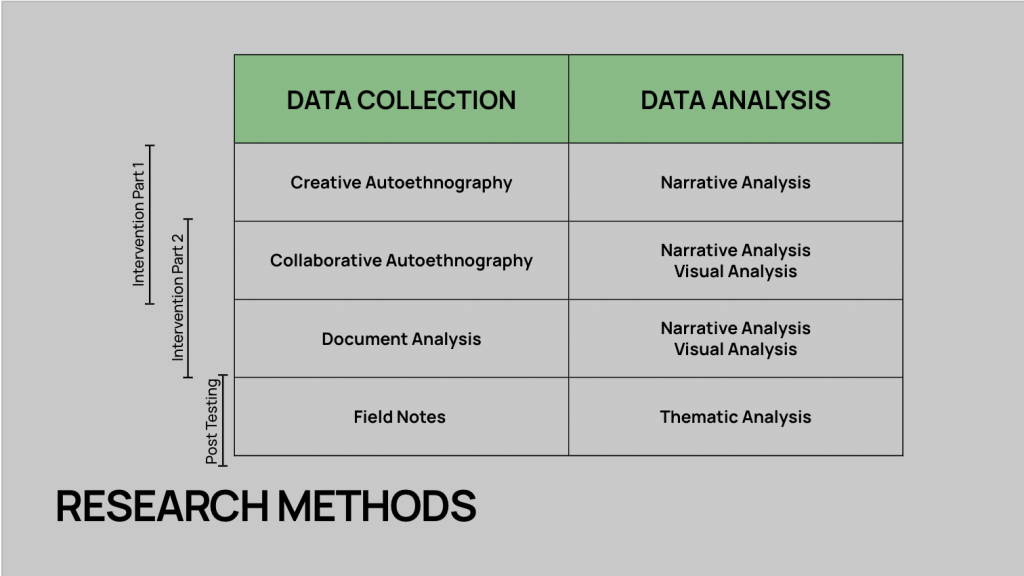
    My PGCert action research project adopts a qualitative, practice-based methodology that foregrounds lived experience, reflexivity and institutional critique. The research design combines creative and collaborative autoethnography, document analysis and field notes, allowing different layers of experience, policy and observation to be examined in relation to one another.

    Creative Autoethnography

    The first phase of the intervention draws on creative autoethnography, positioning personal narrative as a legitimate site of knowledge production. Students write a personal narrative and translate their own life stories into data visualisation using structured prompts, moving from formative experiences to present identity and future orientation. The focus is on their emotional trajectory. This method aligns with creative autoethnography’s emphasis on embodied, evocative storytelling as a way of making sense of experience within wider cultural and educational contexts (Ellis and Bochner, 2006).

    Collaborative Autoethnography

    The second phase employs collaborative autoethnography, shifting from individual reflection to collective sense-making. This dialogic process reflects collaborative autoethnography’s capacity to surface shared tensions and institutional constraints through collective reflection (Arnold and Norton, 2021). Students collectively compare their narrative infographics with the information requested in a UAL Equality, Diversity and Inclusion monitoring form. By removing elements of their stories that were not represented in the form, they identified gaps between lived experience and institutional categorisation.

    Document Analysis

    Document analysis is used to critically examine the DEI monitoring form as an institutional artefact. Treating the document as a social text enables questions of representation, omission and standardisation to emerge, situating personal narratives in relation to policy language and bureaucratic structures (Bowen, 2009).

    Field Notes and Post-Intervention Reflection

    Finally, field notes are used after the intervention to record observations, affective responses and emerging tensions. These notes function as a reflexive account of the research process, acknowledging the partial, situated and interpretive nature of observation in educational settings (Jones et al., 2010).


    Bibliography

    Arnold, L. and Norton, L. (2021) ‘Problematising pedagogical action research in formal teaching courses and academic development: a collaborative autoethnography’, Educational Action Research, 29(2), pp. 328–345.

    Bowen, G.A. (2009) ‘Document analysis as a qualitative research method’, Qualitative Research Journal, 9(2), pp. 27–40.

    Ellis, C. and Bochner, A.P. (2006) ‘Analyzing analytic autoethnography’, Journal of Contemporary Ethnography, 35(4), pp. 429–449.

    Jones, L., Holmes, R., MacRae, C. and MacLure, M. (2010) ‘Documenting classroom life: how can I write about what I am seeing?’, Qualitative Research, 10(4), pp. 479–491.

  • Action Research Mapping

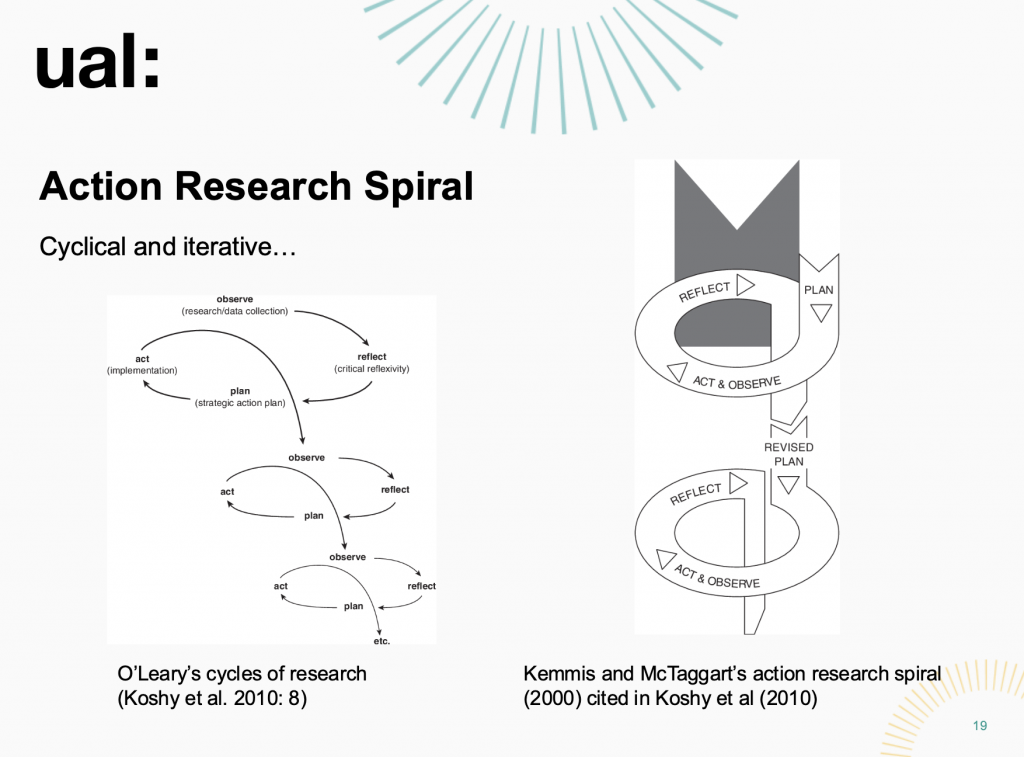
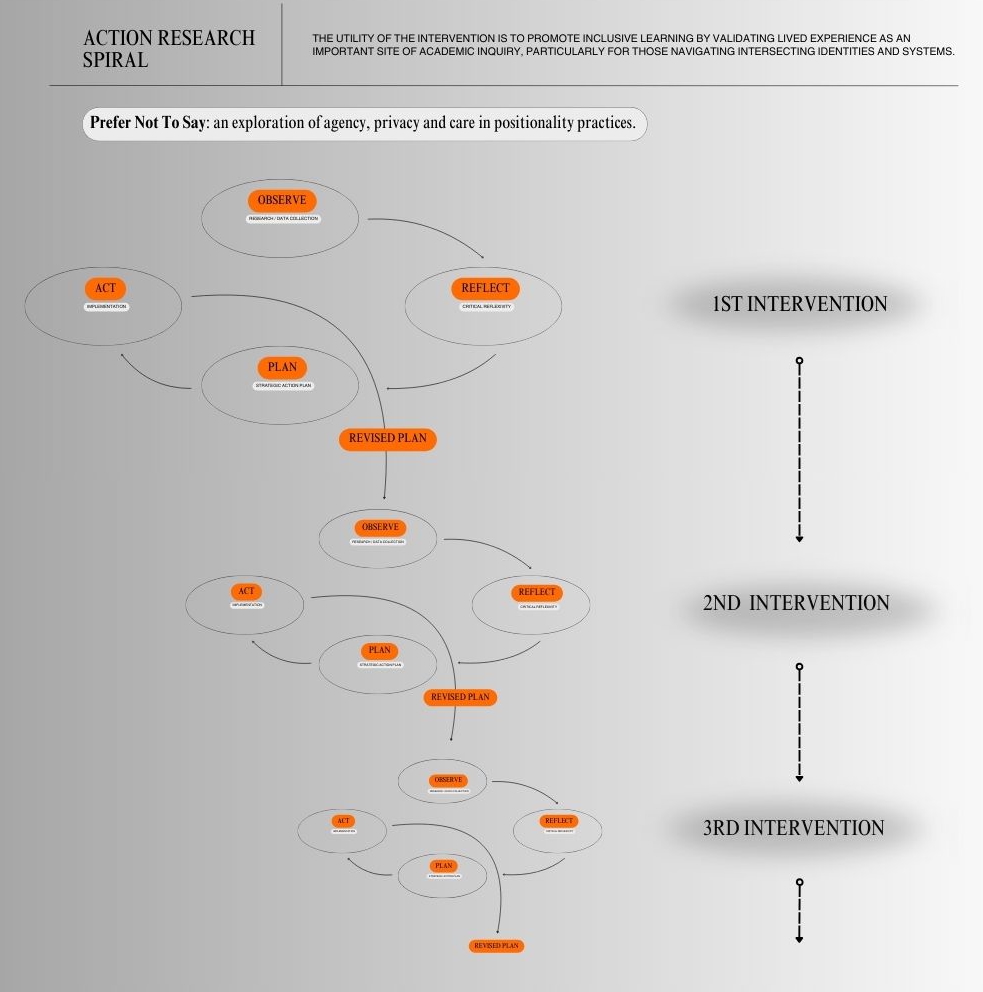
    Action research is often described as a spiral, foregrounding the ongoing relationship between action, observation, reflection and revision. In this blog post, I draw a parallel between this methodological structure and my own research process, questioning where the spiral meaningfully begins and how its stages overlap in practice. Here, observing and acting are often entangled, and each revised plan emerges as both an outcome and a new point of departure.

    What is my starting point in the Action Research Spiral?

    In my experience, both O’Leary and Kemmis & McTaggart’s elements are relevant: first, the breakdown of act and observe (even though both are present in the testing of the intervention). From the latter, I found it helpful to embed the ‘Revised Plan’ within the spiral to separate reflection from consequential planning.

    My own action research spiral:

    Positionality is often not supported in ways that allow students to participate without exposing themselves in the classroom, and it’s not necessarily contextualised within the institution in which they’re situated.

    Data: UAL Equality Diversity and Inclusion Data report 2024

    IP Reflective Report

    Intervention Aims:

    • To promote inclusive learning by validating lived experience as an important site of academic inquiry, particularly for those navigating intersecting identities and systems.
    • To address the choice of exposure when discussing one’s own positionality, and take into consideration the emotional labour implied.
    • To reframe how DEI data is being collected and analysed.
    • In-depth development of the workshop
    • Outline of methods/methodology of research
    • Outline of data collection strategy
    • Setting up the session with the course team
    • Comms to share with students beforehand

    Students will translate their personal narratives into heatmaps shared in real time with the whole class.

    Students will delete from the heat map the parts that the DEI monitoring form doesn’t cover.

    Students will collectively reflect on their own experiential knowledge and the context of institutionalised education.

    Researcher’s input

    • Post-workshop data collection on students’ experience
    • Data visualisation + analysis
    • Reflection on overall process and students and staff’s feedback and testimonies.

    I then developed a draft of the mapping of my Action Research Spiral:

  • Intervention Information Sheet & Participant Consent Form – not part of summative.

    This blog post isn’t part of summative submission.

    The Intervention Information Sheet was sent to students one week before testing the intervention. It provides an overview of the purpose of the study, what participation involves (including right to withdraw), how data will be anonymised at the point of collection, wellbeing considerations, and the use and dissemination of findings.

    As part of this intervention, participants were provided with a consent form outlining the scope of the research, their role within it, and their rights as contributors. The form ensures that participation is fully informed and voluntary, clarifying how data will be used, anonymised, and disseminated, as well as participants’ right to withdraw at any stage without disadvantage.

  • Ethical Action Plan & Research Question

    Following feedback from my ARP tutor, I further developed the Ethical Action Plan. These were the main points addressed:

    • I moved content relating to the intervention into earlier sections to provide greater clarity on my actions.
    • Defined the working title.
    • Referenced relevant UAL documents.
    • Mapped my actions against the stages of the action research cycle.
    • Clarified whether participants can opt in or opt out, whether participation is voluntary or part of the curriculum, and the implications of opting out, such as attendance.
    • Included more information about the student cohort and proposed participant numbers.
    • Identified practical UAL resources, links, and support services to signpost participants to.
    • Clarified the collection of physical data such as paper questionnaires and digital data such as interview recordings, including how data will be stored securely and destroyed after use.
    • Reflected on the ethical considerations related to my role as the researcher.

    The development of the Ethical Action Plan further consolidated the framing of my research question:

    How might choice-based and abstracted approaches to positionality enable students to engage critically without being compelled into disclosure within institutional DEI frameworks?